Build a single app kiosk
Last updated April 29th, 2026
A single-app kiosk offers a full-screen interface of one app that you choose. In Knox Manage new console, single-app kiosks are configured from the Profiles and policies page.
Prerequisites
To start building a single-app kiosk, you must first create a profile, following the workflow up to the Configure screen.
If you already have a profile with a single-app kiosk policy, you can edit the profile, following the workflow up to the Configure screen.
On the Configure screen:
-
Click the Kiosk settings policy.
-
Select Single-app mode.
-
Click SELECT APP.
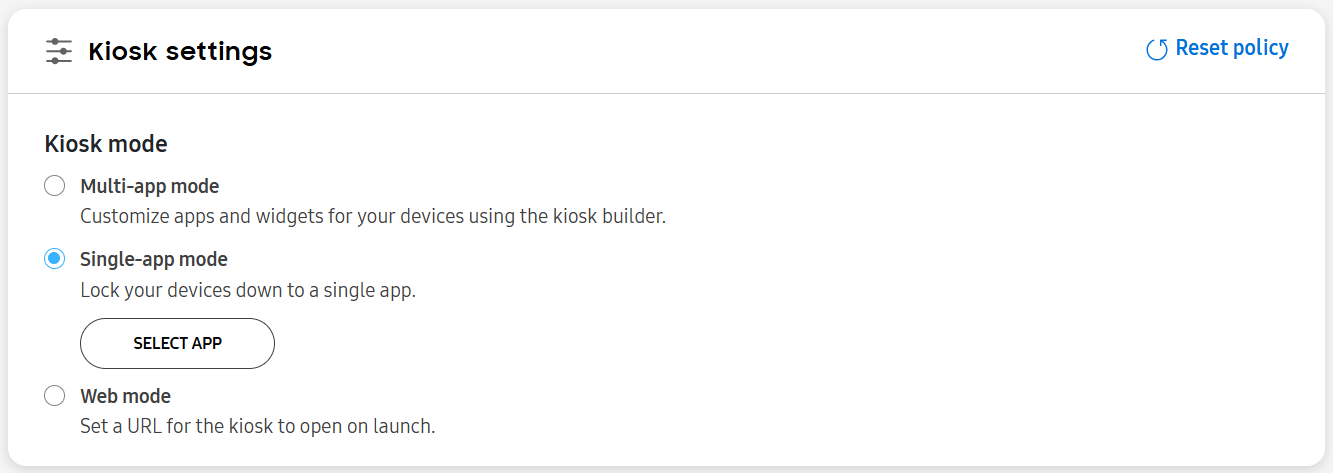
Choose an app to add
-
On the Select app page, choose one app from the list on the APPS, IN-HOUSE APPS, or SYSTEM APPS tab.
Alternatively, use the search bar to find an app by name.
On the SYSTEM APPS tab, click ADD SYSTEM APP to add a system app the list. For all other apps, you must add them to your tenant’s apps list first. For more information on how to add apps, see Add apps.
-
Click CONFIRM. You’re brought back to the Kiosks settings page.
Configure policy settings
After choosing an app, you can configure these additional policy settings:
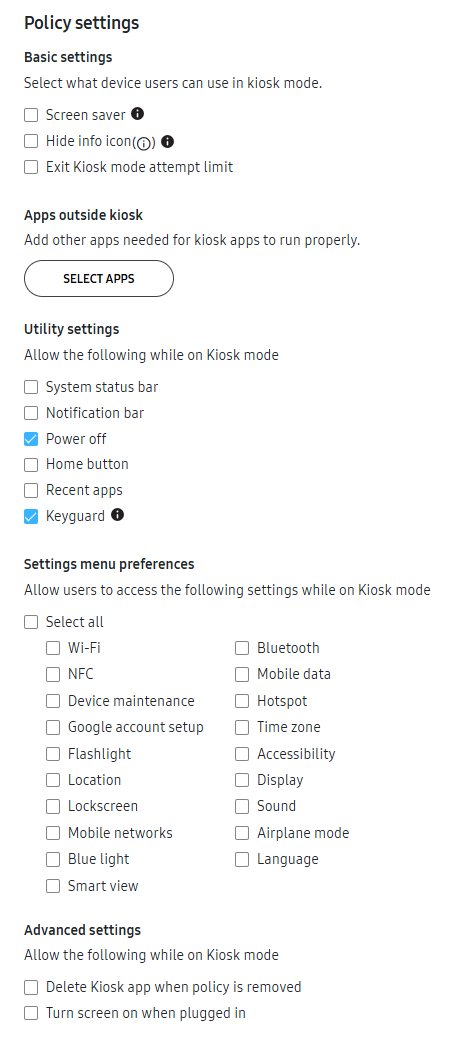
Basic settings
-
Screen saver — Set a screen saver to display when the device is charging or the session times out.
- Images — Upload up to 10 images (maximum 5 MB per image) to display for the screensaver. PNG, JPG, JPEG, and non-animated GIF file formats are supported.
- Video — Upload a video (maximum 50 MB) to display for the screensaver. MP4 and MKV file formats are supported.
-
Hide info icon — Hides the info icon (i) on the interface. Tapping the info icon (i) opens options for the user to leave Kiosk mode or view the license.
If the info icon is hidden and the device isn’t connected to a network, Kiosk mode can’t be exited.
-
Exit Kiosk mode attempt limit — Prevents exiting Kiosk mode following a maximum number of invalid attempts. If this setting is selected, the default maximum is five attempts.
- Take action if attempts are exceeded — Set a delay of 10 minutes or 30 minutes to prevent a user from re-entering the Exit kiosk code after they exceed the attempt limit.
Apps outside kiosk
Sometimes, your kiosk’s proper operation may require other apps to run in the background. To choose apps to keep running:
-
Click SELECT APPS.
-
On the Select app page, choose apps from the list on the APPS, IN-HOUSE APPS, or SYSTEM APPS tabs.
Alternatively, use the search bar to find apps by name.
-
On the SYSTEM APPS tab, click ADD SYSTEM APP to add a system app to the list.
-
Click CONFIRM. You’re brought back to the Kiosks settings page.
Utility settings
Choose to allow the following system elements to be displayed, or actions to be performed.
- System status bar — Enables the system status bar.
- Notification bar — Enables notifications. Selecting this will also enable the Home button setting.
- Power off (default on) — Enables the power menu to turn off the device.
- Home button — Enables the home button.
- Recent apps — Enables the recent app button (also known as the Recents button).
- Keyguard (default on) — Allows your Lock screen policy to apply to the device. If deselected, the device doesn’t won’t be protected by a lock screen, and the device user can access the device without first unlocking it.
Settings menu preferences
Choose to allow users to access and configure the following settings while in Kiosk mode.
- Select all
- Wi-Fi
- NFC
- Device maintenance
- Google account setup
- Flashlight
- Location
- Lockscreen
- Mobile networks
- Blue light
- Smart view
- Bluetooth
- Mobile data
- Hotspot
- Time zone
- Accessibility
- Display
- Sound
- Airplane mode
- Language
Advanced settings
- Delete Kiosk app when policy is removed
- Turn screen on when plugged in
- AC charger
- USB charger
- Wireless charger
On this page
Is this page helpful?