Knox Guard frequently asked questions
Last updated April 16th, 2026
Refer to this FAQ to familiarize yourself with questions other Knox Guard users frequently raise with the Samsung Knox team.
Knox Guard is a risk-management solution enabling protection schemes against fraud, loss, theft, or financial default across all devices, straight out of the box. Knox Guard helps you secure your device payment plans and maintain control of devices using device restrictions, locking methods, and granular notification options.
You need both a Samsung account and a Knox account to access Knox Guard.
You must purchase a license to use Knox Guard. Contact our sales team or your local Knox license reseller to buy one. Once purchased, access the Knox Guard console and enter your license key. After your reseller uploads devices to your console using your Customer ID, a license is automatically assigned to a device when it’s accepted.
The trial license includes all basic Knox Guard features without any restrictions. You can set up your Knox Guard account and remotely manage, notify, and if necessary, lock your Samsung devices.
While we suggest that you apply the Knox Guard commercial license key as soon as possible for your convenience, the trial license is valid for a 90-day activation period and a maximum of 30 devices (on a per-device basis). Once you activate a commercial license, you’re free to use the enrolled devices with this trial license during the service period up to three years.
To use advanced features, such as configuring app blocklists or applying wallpaper restrictions, you’ll need a Knox Guard Advanced commercial license.
For more information on the types of licenses available and how to obtain a license, see Manage licenses.
You can apply for a Knox Guard trial when you create a Samsung account. For more information, see the Getting started with Knox Guard video.
All Knox Guard customers organized into tenant domains (also simply referred to as domains) based on their use case. Domains provide an organized and secure way to enable specialized permissions, and allow us to recommend optimal features for your business operations. Currently, there are four domains available in Knox Guard: Device Financing, Device Insurance, Enterprise, and Other.
All new customers are prompted to select a domain when registering for Knox Guard. For existing customers, your tenant’s super admin can select a domain when they sign in to the Knox Guard console. Depending on the domain you select, some features may automatically be enabled for your tenant.
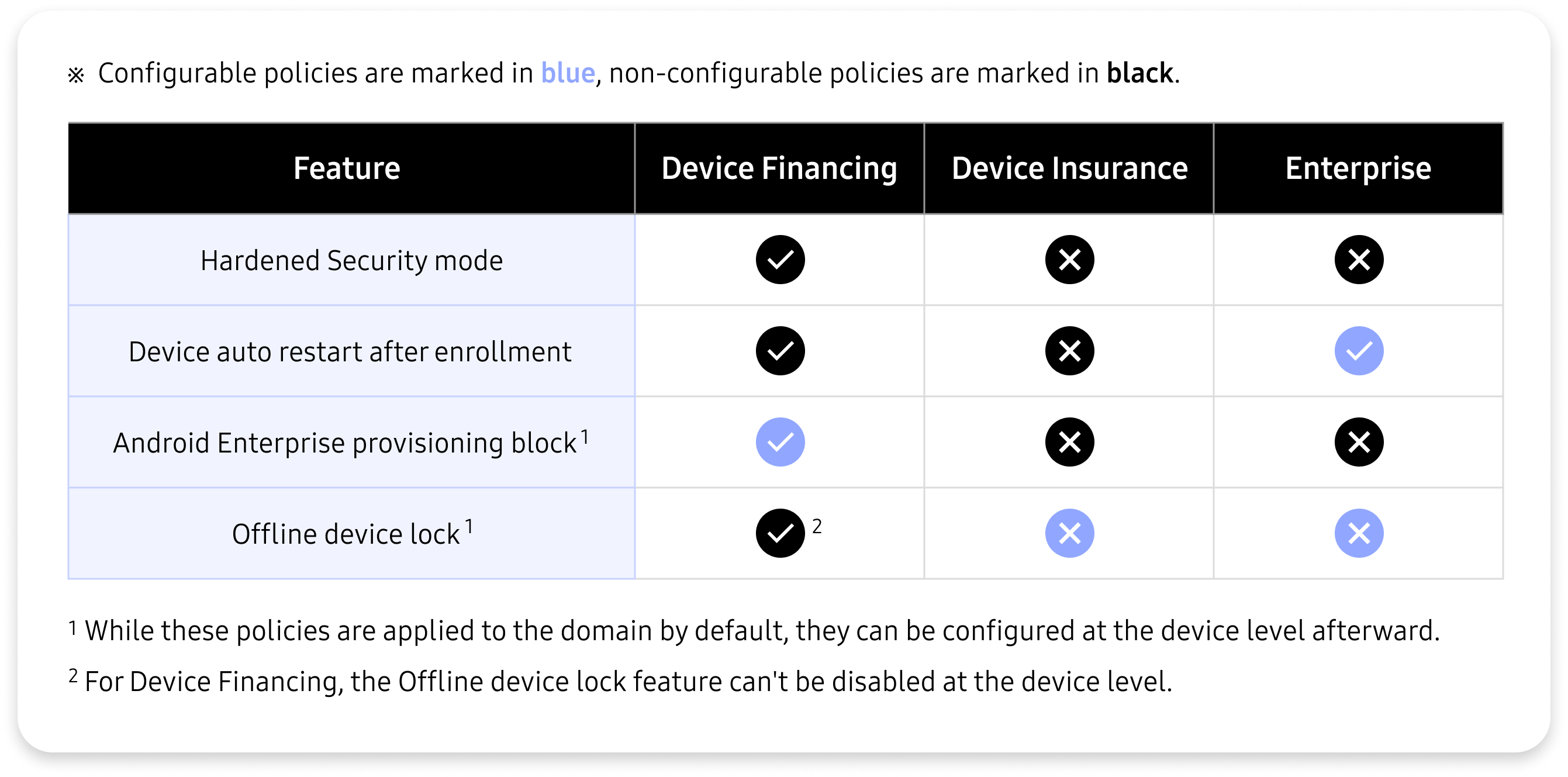
For more information on the available domains, and how to select a domain, see Tenant domains.
Hardened Security mode is Knox Guard’s latest enhanced security feature, available exclusively to customers with the Device Financing domain.
When you add a device with hardened security architecture to a financing domain, a unique set of security mechanisms and policies are automatically applied to deter hacking. This includes:
- Default lock: Ensures the device is locked when an error occurs.
- Hacking lock: A system for detecting potentially malicious behavior and locking in the event it’s discovered.
- Multi-layer lock: Devices are secured on multiple layers, ensuring that a compromise at one point won’t impact other locking components.
- Date and time settings block: Devices leverage automatic date and time settings. Users can’t configure the device’s date and time.
Hardened Security mode is mandatory for device financing customers, and can’t be reversed once applied. In addition, devices configured with Hardened Security mode can’t be uploaded to a non-financing tenant, even if they are removed from Knox Guard.
For more information on Hardened Security mode and whether this feature suits your business needs, see Hardened Security mode.
Yes. The existing configuration data remains on the tenant that you created during your free trial. Once a commercial license is registered, it’s used from then on in the Knox Guard portal. For more information about this process, see Manage licenses.
Knox cloud services are officially supported on Samsung devices running any of the five most recent major Android versions, including the latest version. Specifically, Knox Guard only supports Samsung devices manufactured with Android 11 or later.
For the most up-to-date list of devices that Knox Guard supports, see Devices secured by Knox.
Once a device is fully paid off, you can end Knox Guard service on the device. Once you set a device’s status to Complete*, all applied policies are removed from the device and it’s no longer tracked or controlled by Knox Guard.
* It may take two days for the device’s status to update to Complete.
The Knox Guard solution is intended for businesses that are looking for ways to secure their enterprise assets or payment plans with ease. It’s recommended for:
- Carriers, device retailers, financial institutions, and companies that resell devices with device financing and subsidies.
- Insurance companies that sell theft and loss protection products.
- Organizations that need theft or asset protection solutions for their devices. For example, large enterprises who wish to adopt higher security, businesses with high turnover wanting to lock devices, and device-leasing businesses.
Yes. Organizations can also protect their company’s device assets with Knox Guard. While UEM solutions are typically used to manage company devices, you can use Knox Guard’s powerful features to lock stolen or lost devices that aren’t enrolled in a UEM solution.
Yes. Knox Guard works seamlessly along with other Knox services such as Knox Configure or Knox E-FOTA.
You may encounter issues when using a device or the Knox Guard console. To address these, you can explore the admin guide to get support, read the troubleshooting guide, or browse our knowledge base articles (KBAs) for up-to-date resolutions to known issues.
For issues that can’t be resolved by using our online resources, you can send us an inquiry or create a support ticket.
Is this page helpful?